How to Choose High-Quality 3D-Printed Fidgets
Last Updated: October 25, 2026
Quick Summary
3D-printed fidgets quality depends on precision, material choice, and control over every detail that mass production cannot match. 3D printing allows makers to dial in exact tolerances, choose durable materials like PETG, and engineer designs around known failure modes, resulting in fidgets with superior tactile experience and longevity compared to mass-produced alternatives.
The sweet spot for fidget infill density is 20-30%, with gyroid or cubic patterns distributing load better than grid patterns.
PETG is tougher and more impact-resistant than PLA, flexing rather than snapping under stress and resisting fatigue better for moving parts.
Layer height of 0.12-0.15mm produces the best balance between smooth surface finish and print time for fidgets.
A quality fidget should survive ten consecutive drops from desk height (about 30 inches) with no visible damage or new wobble.
Table of Contents
What Makes 3D-Printed Fidgets Stand Out
3D-Printed Fidget Toy Durability: Why It Matters
The Failure Modes That Actually Matter
Infill Density and Structural Integrity
Drop Resistance and Long-Term Performance
Why Durability Varies Between Makers
PLA vs. PETG for Fidget Toys: Material Selection Guide
Print Quality and Surface Finish: The Tactile Experience
Layer Height and Layer Lines
Post-Processing for Smooth Movement
3D-Printed Fidget Toy Safety: What You Need to Know
Material Suitability
Small Parts, Magnets, and Bearings
Age Suitability and Edge Inspection
A Simple Pre-Use Safety Checklist
Best 3D-Printed Fidget Toys for Different Needs
Articulated Designs for Continuous Motion
Precision-Engineered Spinners and Sliders
3D-Printed vs. Mass-Produced Fidgets: A Direct Comparison
Order Your Custom 3D-Printed Fidget Today
Frequently Asked Questions
What Makes 3D-Printed Fidgets Stand Out
The difference between a mass-produced spinner and a well-made 3D-printed fidget comes down to precision, material choice, and control over every detail, factors that directly impact 3D-printed fidgets quality. 3D printing lets makers dial in exact tolerances and iterate in ways injection molding can't match.
The tactile experience matters. A fidget with poor layer finish feels cheap and distracting; a smooth, well-finished one becomes something you actually want to hold.
At Carolina Printworx3D, we focus on these details because they separate a fidget you'll use from one that sits in a drawer.
3D-Printed Fidget Toy Durability: Why It Matters
Durability determines whether a fidget becomes part of your daily routine or breaks after a few weeks. The best 3D-printed fidget toys are engineered for real-world stress.
Durability isn't uniform across the category. Two fidgets printed from the same file on different machines can behave very differently after a month of use, so judge a specific product rather than assuming all 3D prints are alike.
The Failure Modes That Actually Matter
Most 3D-printed fidget failures fall into a few predictable categories:
Layer adhesion failure. Parts split along layer boundaries when the print ran too cool, too fast, or in a drafty enclosure. The crack usually appears at a stress concentration, not in the middle of a flat wall.
Brittle fracture. PLA in particular snaps rather than yields under impact, especially in thin walls and sharp internal corners.
Joint wear and slop. Repeated motion enlarges clearances between moving parts, producing wobble, rattle, or binding long before anything actually breaks.
Fastener and insert pull-out. Threads stripped into bare plastic, or heat-set inserts that were installed too hot or too cold, fail under repeated disassembly.
Bearing seat distortion. Press-fit bearing pockets that were modeled slightly undersized can crack the surrounding wall, while oversized pockets let the bearing walk and wobble.
A maker who understands these modes designs around them: fillets instead of sharp corners, consistent wall thickness, and material-calibrated clearances.
Infill Density and Structural Integrity
Infill density is critical to fidget durability. At 15% a fidget feels hollow and breaks easily; at 100% it's unnecessarily heavy and expensive. The sweet spot for most fidgets is 20-30% infill.
Infill pattern matters as much as density.
When choosing a 3D-printed fidget, ask about infill percentage and wall count, direct indicators of how well the toy will hold up.
Drop Resistance and Long-Term Performance
Fidgets get dropped, so a quality 3D-printed fidget should survive repeated falls from desk height without cracking. That requires both material choice and design: rounded edges and consistent wall thickness distribute impact force.
You can evaluate drop resistance without a lab.
Long-term performance depends on how moving parts behave over time. A spinner or slider that feels crisp on day one but develops friction or wobble after a month wasn't made with durability in mind.
Pro Tip When evaluating a specific fidget, ask the maker three questions: what material, what wall count and infill, and whether the moving parts were test-cycled before shipping. Makers who can answer specifically are usually the ones whose prints hold up.
Why Durability Varies Between Makers
Printer calibration, filament moisture, ambient temperature, nozzle wear, and slicer profile all influence how strong a print turns out. Tie durability claims to a specific maker and product, and inspect your first print for the failure signs above before relying on it daily.
PLA vs. PETG for Fidget Toys: Material Selection Guide
Material choice changes how a fidget feels, performs, and lasts.
PLA is easier to print, produces a slightly smoother surface finish straight from the printer, and costs less.
PETG is tougher and more impact-resistant, flexing slightly rather than snapping, so it handles drops and stress better than PLA.
If you're buying a 3D-printed fidget and durability is important, ask what material it's made from.
Print Quality and Surface Finish: The Tactile Experience
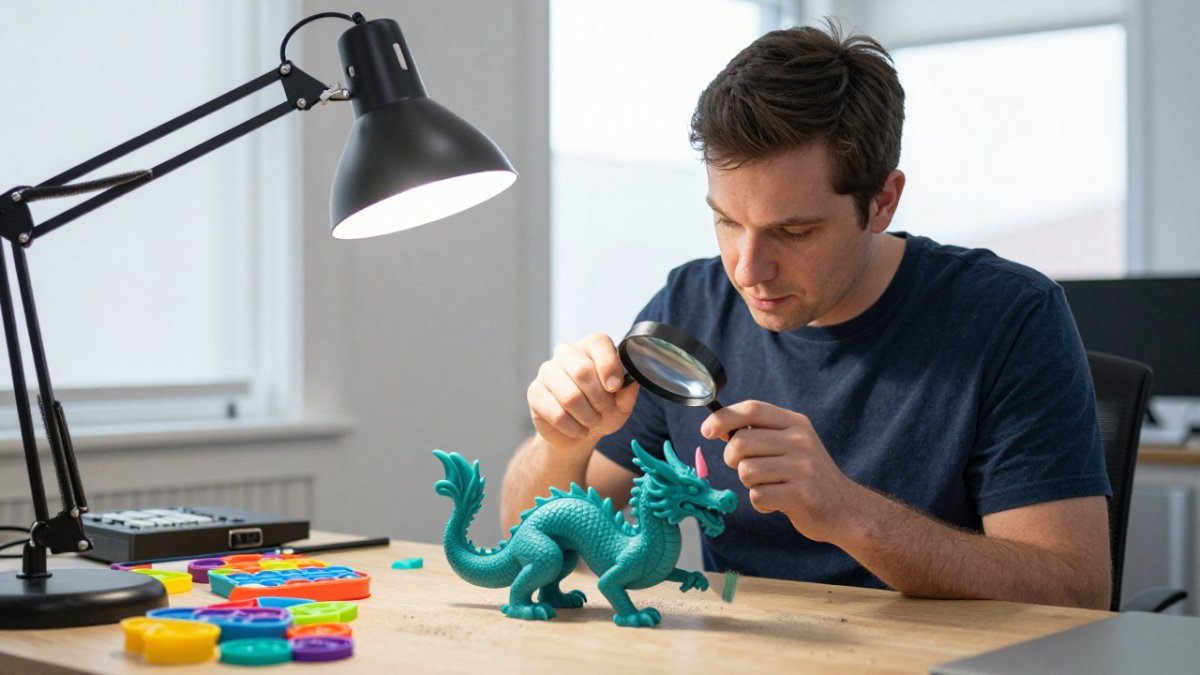
Print quality determines whether a fidget feels premium or cheap. Visible layer lines, rough spots, or inconsistent texture pull your attention away from the calming effect you're seeking.
Layer Height and Layer Lines
Layer height directly affects surface finish. At 0.2mm a fidget shows visible lines; at 0.1mm it looks smoother but takes longer to print.
Layer lines aren't just cosmetic. They create friction points that can make movement feel rough or scratchy.

Post-Processing for Smooth Movement
Post-processing separates good fidgets from great ones. Sanding, polishing, or chemical smoothing removes layer lines and creates a premium surface that feels noticeably smoother than one straight off the printer.
For moving parts like sliders or spinners, post-processing is essential. Roughness on interacting surfaces creates friction and makes the fidget feel sluggish.
3D-Printed Fidget Toy Safety: What You Need to Know
Safety matters, especially for younger users or people with sensory sensitivities. The best 3D-printed fidgets prioritize safety without sacrificing quality. Here are the practical checks that matter when deciding whether a specific fidget is safe for a specific person.
Material Suitability
PLA and PETG are widely used for fidget toys and generally considered non-toxic in finished form.
Filament additives matter too. Glow-in-the-dark, metallic, and some specialty filaments contain mineral or metal powders that can abrade nozzles and leave rougher surfaces. If a maker cannot tell you the base polymer and whether the filament is plain or specialty, treat that as a yellow flag.
Small Parts, Magnets, and Bearings
Small parts are the most common safety concern with 3D-printed fidgets, with magnets, ball bearings, and press-fit pins the usual culprits. A well-made fidget embeds these components so they cannot work loose under normal handling.
A practical retention check: hold the fidget and shake it firmly next to your ear. Any rattle suggests a loose component.
Watch Out Magnets and small bearings are choking hazards and are also dangerous if swallowed together or with other metal objects. Keep high-magnet fidgets away from young children and from anyone who might put them in their mouth, and seek medical attention immediately if a magnet is swallowed.
Age Suitability and Edge Inspection
Age suitability isn't just about small parts. Check for sharp edges, burrs, and support-material remnants, especially on articulated designs. Run a finger along every edge; if anything catches, that's both a quality-control and a safety issue.
For younger users, prefer designs with no detachable components, no magnets, and no exposed bearings, and confirm that articulated joints cannot be forced apart by hand.
A Simple Pre-Use Safety Checklist
Before you rely on a new 3D-printed fidget, run through this checklist:
Confirm the base material with the maker (PLA or PETG are the common choices).
Shake test for rattles and loose components.
Fingernail test each magnet and bearing for movement.
Run a finger along all edges for burrs and sharp points.
Confirm no small parts are detachable by hand.
Match the design to the user: no magnets or small parts for young children.
A fidget that sheds parts during regular handling is unsafe and poorly made. Buying from a maker who can answer material and component questions, and who inspects before shipping, is the most reliable way to reduce risk.
Best 3D-Printed Fidget Toys for Different Needs
The best fidget for you depends on what you're looking for: continuous motion, precise mechanical feedback, or tactile stimulation. You can discover the best fidget toys for adult focus with detailed comparisons and guidance on selecting the right option for your needs.
Articulated Designs for Continuous Motion
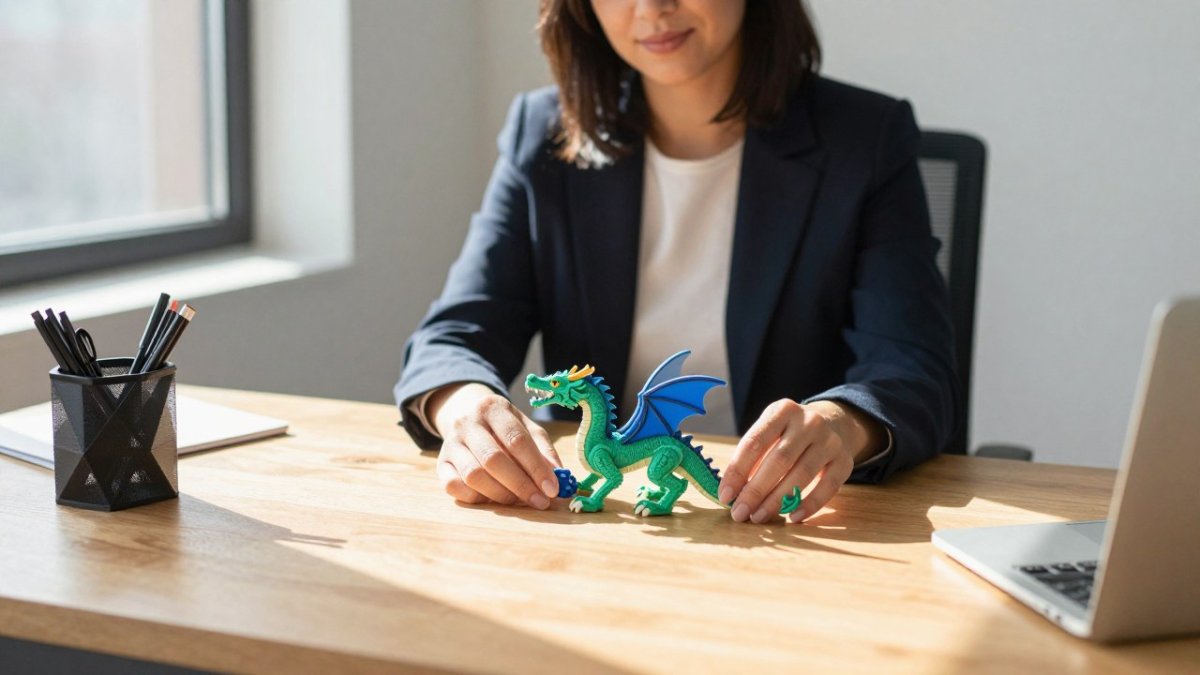
Articulated fidgets feature linked segments that move fluidly through a range of motion. These toys appeal to people who want continuous, flowing movement rather than discrete actions.
Quality articulated designs require precise tolerances between segments. Each joint must be tight enough to feel controlled but loose enough to move smoothly, which is where 3D printing shines.
Precision-Engineered Spinners and Sliders
Spinners and sliders demand precision. A spinner that wobbles or doesn't spin smoothly isn't doing its job. A slider that catches or feels gritty defeats the purpose.
Quality spinners maintain consistent spin time and smooth, quiet operation. Quality sliders move with minimal friction and no grinding sounds. Both require attention to material choice, bearing quality, and surface finish, details that separate a premium fidget from a mediocre one.
3D-Printed vs. Mass-Produced Fidgets: A Direct Comparison
Mass-produced fidgets are cheap and widely available, but they come with trade-offs. Here's how they compare to quality 3D-printed alternatives:
Aspect | 3D-Printed Fidgets | Mass-Produced Fidgets |
Customization | Fully customizable design | Fixed designs only |
Material choice | Select specific materials for performance | Limited material options |
Surface finish | Can achieve premium smooth finishes | Often rough or inconsistent |
Durability | Engineered for specific use cases | Generic, often breaks quickly |
Mechanical precision | Tight tolerances for smooth movement | Loose tolerances, often wobbles |
Cost | Variable, depends on complexity | Very low, but lower quality |
Repairability | Can replace or repair individual parts | Usually disposable |
The key difference is intentionality. A 3D-printed fidget is designed with specific performance goals; a mass-produced one is optimized for cost and volume. Hold a quality 3D-printed fidget next to a cheap mass-produced alternative and the difference is immediately obvious in weight, surface feel, movement quality, and durability.
Mass-produced fidgets have their place if you need dozens for a group. But for a fidget you'll actually use and enjoy, a quality 3D-printed fidget delivers noticeably better performance and longevity.
Order Your Custom 3D-Printed Fidget Today
Choosing the right fidget means understanding what makes one quality fidget different from another. Print quality, material selection, durability engineering, and tactile detail all matter.
Carolina Printworx3D specializes in high-quality 3D-printed fidgets designed for real use. Whether you want an articulated design for continuous motion or a precision spinner for focused fidgeting, you can browse our specialty prints to see what's available.
If you have a specific design in mind, you can also explore custom 3D printing options.
The difference between a fidget that works and one that delights comes down to quality.
Frequently Asked Questions
What makes a 3D-printed fidget toy feel high quality?
High-quality 3D-printed fidgets combine precise mechanical design, smooth surface finish, and durable materials. Layer height directly affects tactile experience, lower layer heights (0.1mm to 0.15mm) create smoother surfaces than standard settings. Quality bearings, proper fit and tolerances between moving parts, and post-processing like sanding or vapor smoothing all contribute to that premium feel. Materials matter too: PETG and nylon hold up better to repeated stress than basic PLA.
Are 3D-printed fidget toys more durable than mass-produced fidget toys?
3D-printed fidgets can match or exceed mass-produced durability when designed and printed correctly. The advantage lies in customization: infill density, material choice, and structural design can be optimized for your specific use. However, durability varies significantly between makers and individual prints. A well-calibrated printer with quality settings will produce fidgets that survive drops and repeated articulation. Mass-produced fidgets offer consistency, but 3D-printed options allow you to choose durability features that matter most to you.
Is PLA or PETG better for fidget toys?
PETG generally outperforms PLA for fidget toys because it resists impact better and handles repeated flexing without cracking. PLA is more brittle and prone to breakage under stress, especially in articulated designs with moving joints. PETG is also more resistant to temperature changes and humidity. If your fidget has tight tolerances or moving parts, PETG is the safer choice. PLA works for simpler designs with less mechanical stress, but for long-term reliability, PETG is worth the investment.
Are 3D-printed fidget toys safe?
3D-printed fidget toys are safe when made from non-toxic materials and designed without small detachable parts. Check that your fidget has no sharp edges, loose components, or small pieces that could pose choking hazards. Always ask makers about their material sourcing before purchasing, especially if the fidget is for children.
Join
Add carolinaprintworx3d.com as a preferred source on Google →
Comments