Best Fidget Toys for Adult Focus: 7 Picks That Work
Last Updated: October 22, 2026
Quick Summary
The best fidget toys for adult focus are quiet, tactile pieces like sliders and textured 3D printed fidgets that keep your hands busy below the desk line without pulling your eyes from the screen. Buy for the setting first and the sensation second, and own two pieces: a silent, neutral one for shared spaces and a louder, more tactile one for solo work.
Tactile fidgets beat visual ones for office work because they happen below the desk line.
A slider is arguably the better office tool than a spinner: silent, with small motion.
Clickers deliver the strongest kinesthetic feedback but make noise, so save them for solo work.
Stress balls and weighted tools suit anxiety management and grounding, not mild restlessness.
Alternate hands every 15 to 20 minutes during long calls to avoid one-sided hand fatigue.
Table of Contents
Why Fidget Toys Help Adults Focus (and What the Research Says)
Tactile vs. Visual Fidgets: Which Type Fits Your Brain
Quick Comparison: Best Fidget Toys for Adult Focus
1. Spinners and Sliders: Repetitive Motion for Concentration
2. Clickers and Mechanical Gear Fidgets: The Kinesthetic Edge
3. Stress Balls and Weighted Tools for Anxiety Management
Quiet Fidget Toys for Adults: Silent Operation That Won't Distract
Fidget Toys for Adults at Work: Desk-Friendly Picks and Professional Optics
What "Professional" Looks Like as a Spec
The Stigma Problem, Handled Directly
The Ergonomic Angle Most Guides Skip
Fidget Toys for ADHD Adults: Matching the Toy to Executive Function Needs
The Executive Function Gaps Fidgets Can Actually Address
A Task-by-Task Matching Guide
The Setting-First Rule
A Short Usage Protocol
Frequently Asked Questions
Why Fidget Toys Help Adults Focus (and What the Research Says)
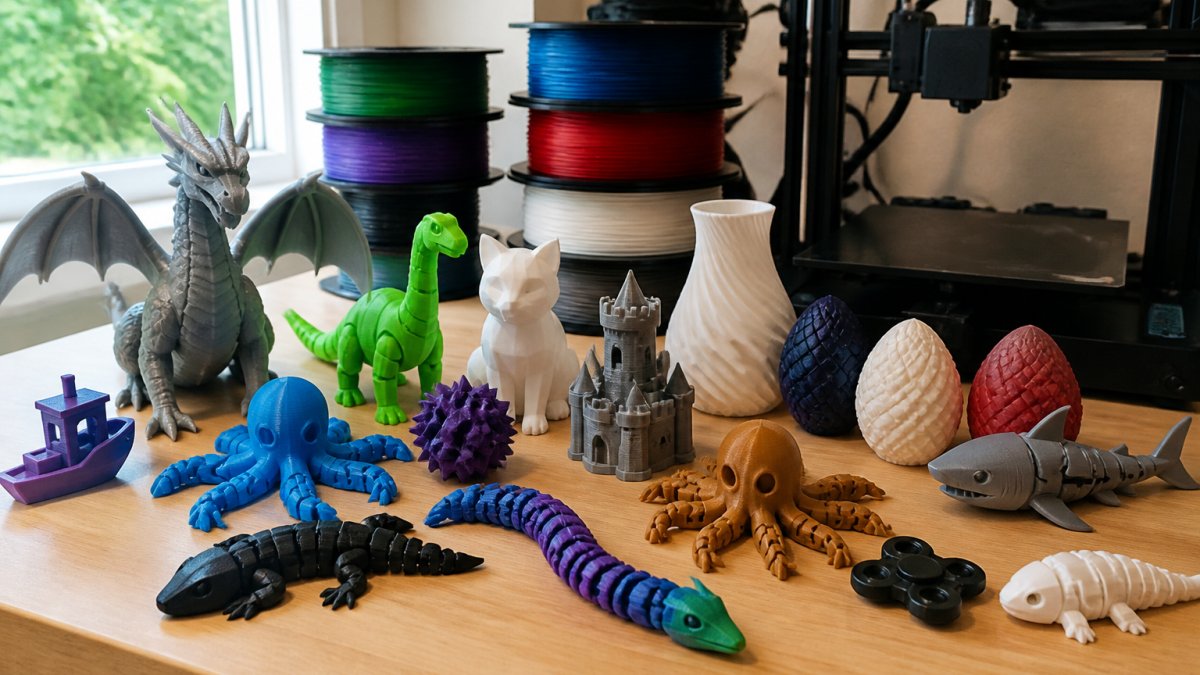
Fidget toys are small handheld objects that channel restless energy through repetitive motion, and adults use them to support concentration during meetings, calls, and deep work. At Carolina Printworx3D, we make and sell 3D printed fidgets, so we have a bias.
The best fidget toys for adult focus are quiet enough to disappear in a meeting and tactile enough to keep your hands off your phone, a point most buying guides bury under novelty shapes.
The mechanism is simple. The American Occupational Therapy Association's guidance on sensory processing is a reasonable starting point if you want the professional framing rather than the marketing version.
Fidgets are not a fix for a diagnosis, they manage restlessness, and plenty of people without any diagnosis use one for the same reason they tap a pen.
Tactile vs. Visual Fidgets: Which Type Fits Your Brain
Tactile fidgets engage your hands through texture, resistance, or motion: stress balls, textured surfaces, clickers, sliders, spinners.
For office work, tactile wins almost every time: a visual fidget pulls your gaze from the screen, while tactile fidgeting happens below the desk line and does not compete with the task.
One exception: if your restlessness shows up as eye strain rather than hand restlessness, a visual piece between tasks can help you reset. Just keep it out of your eyeline while reading.
Quick Comparison: Best Fidget Toys for Adult Focus
Type | Best For | Noise Level | One-Handed? | Desk-Friendly |
Spinners and sliders | Repetitive motion, meetings | Silent to low | Yes | Yes |
Clickers and gear fidgets | Kinesthetic feedback | Audible click | Yes | With caution |
Stress balls and weighted tools | Anxiety management | Silent | Yes | Yes |
Textured 3D printed pieces | Discreet fidgeting | Silent | Yes | Yes |
1. Spinners and Sliders: Repetitive Motion for Concentration
Spinners and sliders are the most reliable category for adult focus because repetitive motion occupies the hands without demanding decisions.
Spinners have a flaw: good ones spin long, but cheap ones wobble and rattle, and a wobbling spinner is worse than no fidget at all because the rattle becomes its own distraction.
Resistance matters more than shape. A slider with a firm, consistent glide keeps your hand busy; a loose one feels like nothing and you stop reaching for it within a week.
2. Clickers and Mechanical Gear Fidgets: The Kinesthetic Edge
Clickers and mechanical gear fidgets deliver the strongest kinesthetic feedback of any category: a definite click, detent, or gear tooth you can feel through your fingers.
The catch is obvious: clickers make noise.
Use clickers at home, in a private office, or on muted calls. For shared desks, save them for solo work and keep a silent piece in your bag for meetings.
3. Stress Balls and Weighted Tools for Anxiety Management
Stress balls and weighted tools serve a different job: anxiety management and grounding, not mild restlessness.
Weighted tools work on a related principle: a slightly heavier piece in your hand or pocket provides steady sensory input without motion, which suits people who find movement itself distracting.
This is the category we recommend for high-stress moments: before a presentation, during a difficult call, or after a hard conversation.
Pro Tip Buy two. One stays at your desk, one lives in your bag. The people who get value from fidgets are the ones who have one within reach at the moment they need it, and that moment is rarely at your own desk.
Quiet Fidget Toys for Adults: Silent Operation That Won't Distract
Quiet fidget toys for adults are pieces with no click, rattle, or impact sound: sliders, textured pieces, weighted objects, and smooth spinning mechanisms with proper bearings.
Auditory distraction is an underrated reason fidgets get abandoned.
When you are evaluating a quiet fidget, test three things:
Sound under load. Does it rattle when you move it fast, not just slowly?
Loose parts. Anything with clearance between components will click eventually.
Surface finish. Rough 3D printed surfaces can scrape audibly against a desk.
That last point is where cheap 3D printed fidgets get a bad name, and fairly so. A poorly finished print has layer lines you can feel and hear.
Fidget Toys for Adults at Work: Desk-Friendly Picks and Professional Optics
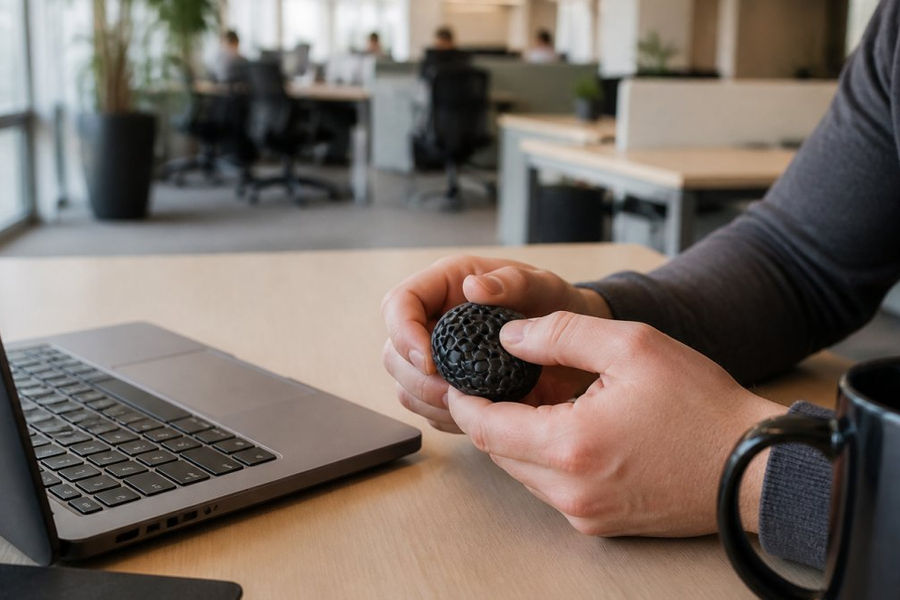
Fidget toys for adults at work come down to optics as much as function. A small, matte, desk-toned piece reads as a desk accessory; a neon spinner reads as a toy, and that perception changes how colleagues and managers treat you.
What "Professional" Looks Like as a Spec
Optics are predictable once you break them into four visible traits:
Color. Neutral and dark tones (charcoal, slate, walnut, matte black) disappear against keyboards, notebooks, and desk mats. Saturated primaries and neons signal "toy" before anyone touches it.
Finish. Matte beats gloss. Glossy plastic catches overhead light and draws the eye across a room; a matte or lightly textured surface stays visually quiet.
Silhouette. Simple geometry (a rounded bar, a flat slider, a smooth stone shape) reads as a desk object. Protruding arms, spinners with tall hubs, and anything with a lanyard read as novelty.
A practical test before bringing a piece into a meeting: hold it at chest height and imagine it in the corner of a video call frame. If it would pull a colleague's eye, it is the wrong piece for that setting, not the wrong fidget, just the wrong room.
The Stigma Problem, Handled Directly
The social stigma is real. Two patterns tend to work:
Normalize by placement, not explanation. A fidget that lives on the desk like a pen cup or a stress ball does not require a speech. The moment you explain it, you have made it a topic.
Match the room. Keep a silent, neutral piece for shared spaces and reserve louder or more tactile pieces for solo work, muted calls, and home. Owning two pieces is cheaper than losing credibility in one high-stakes meeting.
If a manager or colleague does ask, the shortest honest answer works best: it helps you stay focused in long meetings. Most people accept that framing because it is true.
The Ergonomic Angle Most Guides Skip
Long-term use matters more than most buyers expect: a fidget held in a pinch grip for hours will fatigue your thumb and fingers, and the ache shows up weeks later. A few rules keep a daily-use piece from becoming a repetitive-strain problem:
Alternate hands. Switch every 15-20 minutes during long calls. This spreads load across both hands and reduces one-sided fatigue.
Favor relaxed grips over pinch grips. A piece you can work with a loose fist or a thumb-and-two-finger roll is easier on the hand than one that requires a tight pinch.
Watch the weight. A weighted piece is grounding for short high-stress moments but tiring if held for an hour. Use weight for grounding, not for all-day fidgeting.
If your hand aches after a meeting, the fidget is the wrong shape for you, not a sign you should stop fidgeting. Swap to a flatter, lighter, or more rounded piece.
Do not buy a fidget with sharp edges or thin protruding parts and use it during calls. A snapped piece in the middle of a client meeting is a distraction you cannot undo, and small broken parts are a choking hazard around children at home.
Keep a "meeting piece" and a "solo piece." The meeting piece should be silent, matte, neutral-colored, and small enough to disappear in a closed hand. The solo piece can be louder, heavier, or more tactile. Buying for both settings costs less than trying to force one piece to do everything.
Fidget Toys for ADHD Adults: Matching the Toy to Executive Function Needs
Fidget toys for ADHD adults work best when the toy matches the specific executive function gap you are trying to bridge. "ADHD" is not one problem, so one fidget type does not fit everyone. The useful version is a map from the task you are struggling with to the sensory input that tends to help, plus a protocol for using it without becoming a distraction itself.
The Executive Function Gaps Fidgets Can Actually Address
Fidgets do not treat ADHD, and they are not a substitute for clinical care. What they can do is occupy the restless channel so the working-memory and task-initiation channels have less competition. Adults tend to reach for a fidget in four situations:
Restless hands during meetings and calls. The hands want a task; the meeting needs your attention. A silent, low-motion piece absorbs the restlessness below the desk line.
Trouble starting a task. Task initiation is one of the hardest executive functions to bootstrap. A short, deliberate fidget session for the first minute or two of a task can act as a physical "start" cue.
Overwhelm and anxiety spikes. When the nervous system is flooded, a firm squeeze or a weighted piece gives a clear physical anchor and a simple next action.
A Task-by-Task Matching Guide
Situation | Best-fit fidget | Why it fits | What to avoid |
Long meetings, shared room | Silent slider or textured flat piece | Low motion, no sound, below the desk line | Clickers, spinners with tall hubs |
Starting a hard task | Clicker or gear fidget (solo use) | Strong detent gives a clear physical "start" cue | Silent pieces that feel like nothing |
Anxiety spike before a call | Firm stress ball or weighted piece | Clear resistance and steady input | Loose, low-resistance pieces |
Long reads or lectures | Small one-handed piece, worked without looking | Keeps hands busy without pulling the eyes | Visual fidgets in the reading line of sight |
Open office, close neighbors | Matte textured piece or smooth-bearing spinner | Quiet and visually neutral | Anything with loose parts or audible detents |
The Setting-First Rule
The common mistake is buying the loudest, most satisfying fidget and then discovering you cannot use it where you actually need it. Buy for the setting first, the sensation second.
A workable pattern is to own two pieces: one silent, neutral piece for shared spaces and one louder, more tactile piece for solo work. That covers the two settings where adults with ADHD most often need support, and it avoids forcing a single piece to do both jobs badly.
A Short Usage Protocol
A fidget works better as a deliberate tool than as a background habit. A simple protocol:
Pick the gap first. Decide whether you need help starting, sustaining, or settling. The gap determines the piece.
Use it for the hard part, then put it down. Two minutes at task start, or the duration of the meeting. The fidget is a tool for the moment, not a permanent attachment.
Alternate hands. Switch every 15-20 minutes to avoid one-sided hand fatigue.
Review after a week. If you stopped reaching for it, the piece is wrong for you, not fidgeting in general. Swap the shape or the resistance before you give up on the category.
We make 3D printed fidget toys in our shop. Discreet fidgeting beats dramatic fidgeting every time, because the discreet piece is the one you will still be using in six months.
If you are weighing materials, budget versus premium matters less than finish: a cheap piece with a smooth surface outperforms an expensive one with rough edges. Ask about finish before price, and check the shop's real customer photos rather than renders.
Frequently Asked Questions
Do fidget toys actually help adults concentrate?
For many adults, yes. Fidget toys give restless hands a low-effort task, which can free up attention for the main work. The effect is strongest for people who naturally fidget, including many with ADHD, anxiety, or sensory regulation needs. The key is choosing a toy that uses minimal cognitive effort. A spinner or textured slider you can use one-handed while reading or on a call tends to help focus. A complex puzzle toy that demands attention can pull focus away instead, so match the toy to the task.
Which quiet fidget toys for adults are safe to use in meetings?
Look for silent operation: soft silicone sliders, textured rings, weighted worry stones, and gear-style fidgets with dampened clicks. Avoid anything with loud clicking, rattling beads, or metal-on-metal contact, since auditory distraction bothers coworkers more than visual movement. A good test is to use the toy under a desk during a video call and check whether anyone on the call notices the sound. If they do, it is too loud for shared spaces. Keep a discreet option in your bag for in-person meetings.
What are the best fidget toys for ADHD adults?
Adults with ADHD often do best with toys that provide steady tactile stimulation without demanding decisions. Spinners, sliders, clickers, and weighted stress balls all work well because they support repetitive motion and self-regulation with minimal executive function load. Many people keep two or three options on hand and rotate them, since novelty helps sustain engagement. Pair the toy with a clear task, like reading or note-taking, so it supports focus rather than replacing it. If focus problems are severe, talk to a clinician alongside trying tools.
Are 3D printed fidget toys as good as mass-produced ones?
They can be better for fit and feel. 3D printing lets makers tune size, texture, and mechanism tension, and printed designs often use layered textures that give strong tactile input. Quality depends on the printer and material: look for clean layer lines, sturdy joints, and safe, non-toxic filament. Printed toys also allow customization, which makes them good gifts. Pricing varies by design and material, so check the maker's site for current options rather than assuming a set cost.
Join
Comments